Skip to content
zenfai
zenfai

One department. One measurable workflow.

ATLAS / CUSTOMER SERVICE

Familiar files. In your company format.

Three prepared samples show how saved templates turn source files into documents your team can review. All public records are synthetic; Atlas is the retained brand.

EXAMPLE / 01
PDF

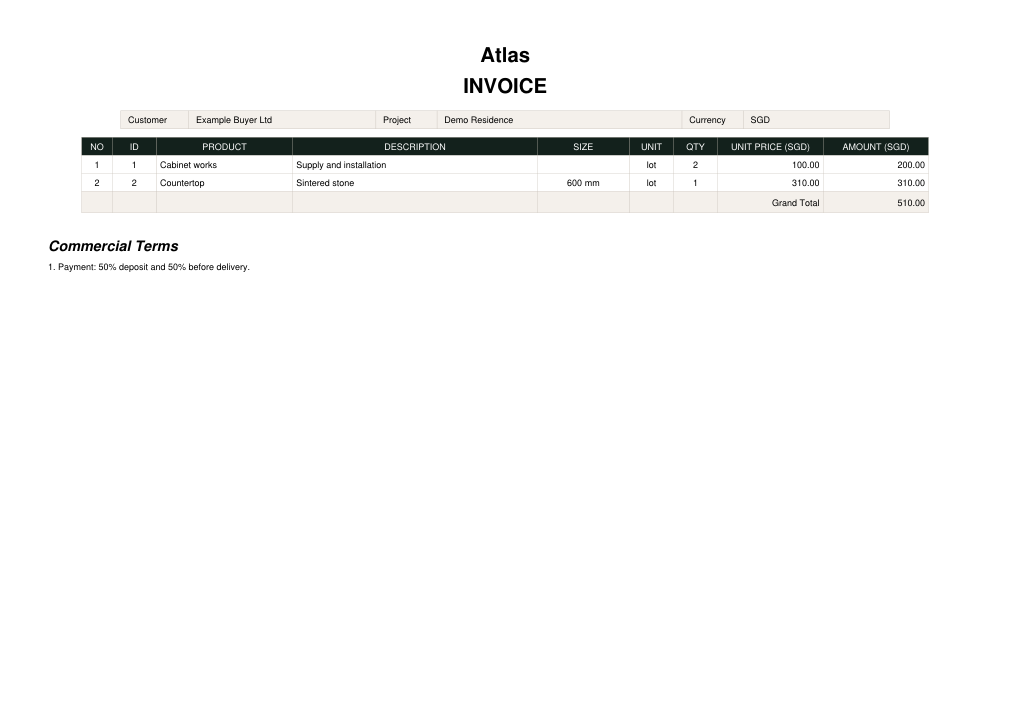
Document to your company template

Keep the facts. Change the presentation. Check the finished document.

You provide
A source quotation or invoice. Your company details and target template are already saved.
You receive
A branded PDF, with the source figures and terms checked.
View sample results: Document to your company template
EXAMPLE / 02
EXCEL + PDF

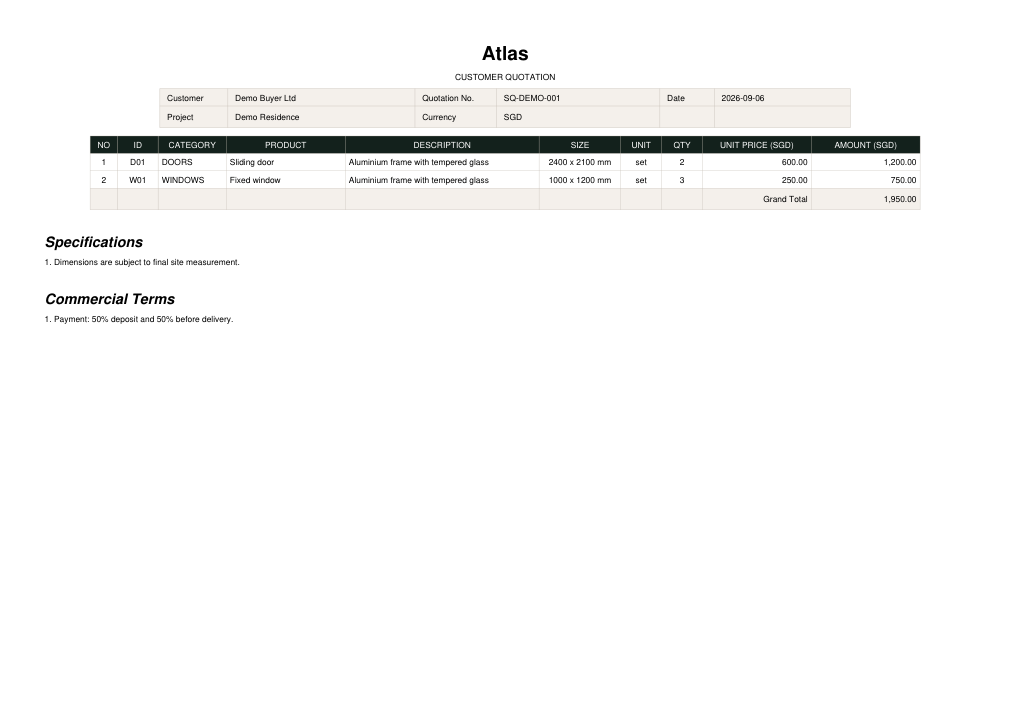
Supplier quote to customer quote

Match each item. Apply your rules. Produce the customer version.

You provide
A supplier quotation. Your customer format, pricing rule and exchange rate are agreed in advance.
You receive
A customer quotation in Excel and PDF, with checked line items and totals.
View sample results: Supplier quote to customer quote
EXAMPLE / 03
EXCEL + PDF

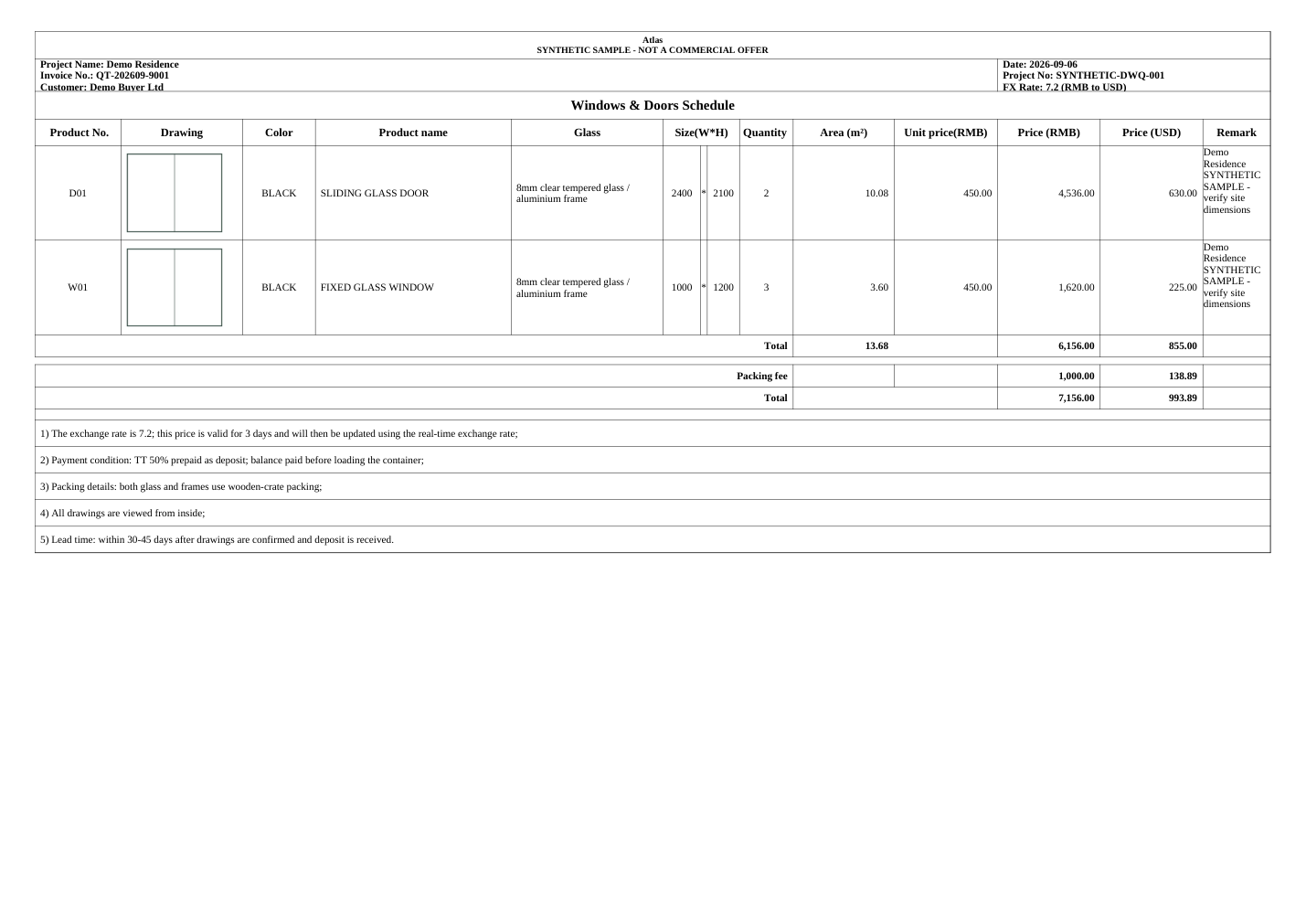
Drawing to quotation

Read the openings. Calculate the areas. Prepare a reviewable quote.

You provide
A door and window drawing. Your template and measurement rules are configured in advance.
You receive
An editable quotation workbook, a PDF, and a record of the checks.
View sample results: Drawing to quotation

Detailed quotation workflow concept

Atlas Lead-to-Approved-Quote

Atlas Building Technology is a real door-and-window business. This public case shows the operating method with synthetic work items, not customer records or achieved performance claims.

The original fragmented process

The work crosses channels, files, specialists, and approvals.

The problem is not a missing chatbot. It is the repeated effort required to assemble reliable context before someone can make a decision.

01

Demand arrives in separate channels

Campaign forms, website enquiries, email, and follow-up context start in different places.

02

Requirements live across files

Messages, schedules, drawings, revisions, and clarification notes must be reconciled.

03

Product evidence must be found

A specialist still needs an approved source for product direction and constraints.

04

Quote decisions are distributed

Technical facts, commercial sources, lead time, and release need named reviewers.

Target Lead-to-Approved-Quote flow

The first proof stops at an internally approved quotation.

Every transition produces something a person can inspect. Customer-facing release remains a named human decision.

  1. 01

    Facebook / Google / Website / Email

  2. 02

    Lead qualification

  3. 03

    Sales follow-up

  4. 04

    Customer files and drawings

  5. 05

    Requirement schedule

  6. 06

    Product recommendation

  7. 07

    Optional visual proposal

  8. 08

    Quote workbook

  9. 09

    Technical and price approval

Department handoffs

Sales hands the request to Customer Service.

AI-prepared work moves forward only after the responsible department reviews its part of the record.

  1. 01

    Sales

    AI prepares

    Customer request, conversation context and confirmed next action

    People approve

    Customer fit and requirement handoff

  2. 02

    Customer Service

    AI prepares

    Requirement schedule and quotation in the agreed template

    People approve

    Source details, technical suitability, commercial terms and release

Customer Service Skills

Three saved tasks, configured around your templates.

Company document conversion, supplier-to-customer quotation, and drawing-to-quotation each have a defined input and reviewable result. The prepared samples above show their outputs. The wider quotation journey below is a concept to scope and validate during a pilot.

Data and material inputs

Controlled source material makes prepared work reviewable.

The Pilot must catalogue where each fact comes from, which version applies, and what is still missing.

Sample lead context

Synthetic example
Lead ID
lead_demo_architect_001
Customer type
Architect
Project country
France
Product interest
Ultra-slim sliding doors
Status
Synthetic example

Approved input classes

  • Qualified lead brief
  • Customer requirements
  • Approved product information
  • Drawings or schedules
  • Quote templates

Sample prepared outputs

Inspect the work, not a performance claim.

These public artifacts demonstrate structure, source status, unresolved questions, and approval boundaries with synthetic values only.

Prepared output 01

Requirement schedule

Synthetic example
OpeningTypeWidthHeightReview state
D-01Sliding door4200 mm2800 mmNeeds confirmation
W-03Fixed glazing1800 mm2400 mmPrepared

Prepared output 02

Product recommendation

Synthetic example
D-01Technical review

Minimal-frame sliding system

Evidence status

Approved catalogue reference located

W-03Prepared

Thermally broken fixed glazing

Evidence status

Product sheet and dimension range located

Prepared output 03

Quote workbook preview

Commercial values are intentionally omitted.

Synthetic example
LineScopeSource statusReview state
Q-01Sliding opening packagePrice source requiredTechnical review
Q-02Fixed glazing packageCatalogue reference attachedDraft
Q-03Installation allowanceAssumption confirmation requiredDraft

Prepared output 04

Approval record preview

Synthetic example

Decision boundary

Technical facts and dimensions

Responsible reviewer: Technical reviewer

Review required

Decision boundary

Product direction

Responsible reviewer: Product specialist

Prepared

Decision boundary

Price, discount, and lead time

Responsible reviewer: Authorized commercial reviewer

Review required

Decision boundary

Customer-facing quote release

Responsible reviewer: Responsible business owner

Human decision

Interactive workflow demo

Follow a synthetic enquiry into a reviewable quotation package.

The Atlas demo will show a controlled case moving through bounded Skills, quality checks, and human approval without asking for customer material.

Synthetic case · no customer upload
  1. 01

    Controlled source

    Synthetic enquiry, opening schedule, and drawing notes

  2. 02

    Prepared work

    Requirements, exceptions, product direction, and quote checks

  3. 03

    Review package

    Workbook, PDF, QA record, and explicit approval boundary

Demo connection in preparation

Human approval boundaries

People approve facts, product choice, commercial terms, and release.

The workflow can prepare evidence and highlight exceptions. It cannot become the accountable technical or commercial decision-maker.

  • Technical facts and dimensions
  • Product selection
  • Price and discount
  • Lead time and final quote release

Final customer-facing action requires a recorded human approval.

Pilot scope and non-goals

Validate one controlled boundary before expanding downstream.

The next implementation proves whether Atlas-specific materials, reviewers, and exceptions can produce a reliable internally approved quote.

Next controlled implementation

Through internally approved quote

  • Configure approved Atlas source materials and review rules.
  • Run controlled examples from qualified lead through internally approved quote.
  • Record unresolved information, source status, reviewer decisions, and revisions.
  • Measure the workflow against an agreed baseline before claiming improvement.

Outside the first proof

Explicit non-goals

  • No autonomous customer-facing quote release.
  • No invented price, discount, product fact, or lead time.
  • No replacement of CRM, file storage, accounting, or ERP systems.
  • No contract, order, delivery, or payment automation in the first proof.

Measurement plan

Baseline first. Pilot targets second. Achieved results only after evidence.

The first run establishes what to compare. Public claims are not created from unverified estimates.

Preparation time

Compare baseline and Pilot time from complete inputs to first reviewable draft.

Pilot target — not an achieved result

Missing requirements

Count unresolved fields identified before technical and commercial review.

Pilot target — not an achieved result

Revision behavior

Record why a draft returns, which source changed, and who resolved it.

Pilot target — not an achieved result

Approval completeness

Check whether every required technical and commercial decision has an owner and record.

Pilot target — not an achieved result

Transferability

The method transfers when the operating pattern is similar.

Other trading and project businesses can use the same workflow shape, but their source materials, rules, products, reviewers, and measurements must be configured separately.

  • Leads arrive through repeated, identifiable channels.
  • The offer depends on drawings, requirements, schedules, or configuration choices.
  • Approved product and company knowledge can be separated from unsupported claims.
  • A responsible person already approves technical and commercial decisions.

Workflow Review

Review a similar lead-to-approved-quote workflow.

Bring one repeated quotation process, its source materials, one responsible reviewer, and the result you want to measure.